
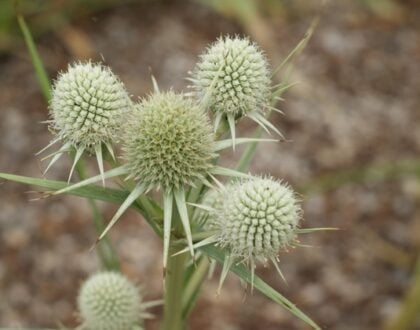
Eryngium yuccifolium
Rattlesnake Master
 Please register or login to build your personal plant list.
Rattlesnake master (Eryngium yuccifolium) is a striking, drought-tolerant native perennial that attracts a wide range of pollinators.
Description:
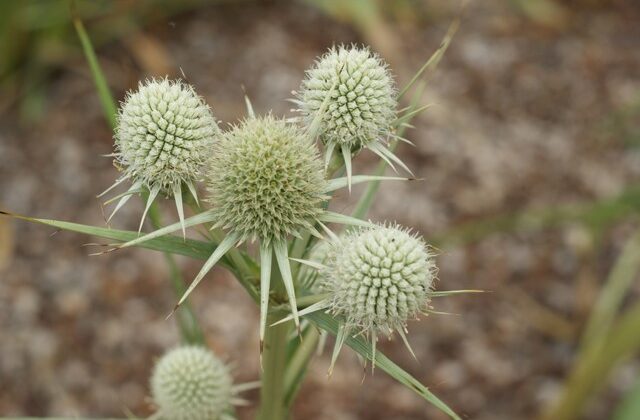
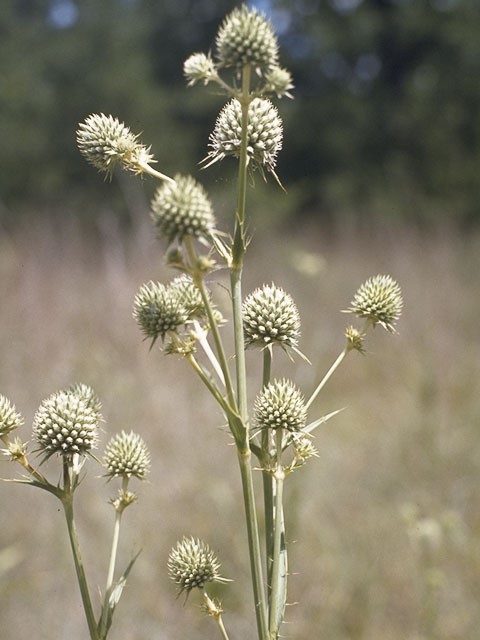
Rattlesnake master is a striking native perennial that brings a touch of the prairie to Jersey yards. Its stiff, upright stems are topped with round, thistle-like clusters of tiny white flowers, while its narrow, yucca-like leaves form a bold, clumping base that adds texture and structure to the garden. This plant is a pollinator powerhouse, drawing a wide range of native bees, butterflies, moths, and other beneficial insects to its blooms. It also serves as a host plant for the larvae of the rattlesnake-master borer moth (Papaipema eryngii).
Blooming from summer into early fall, rattlesnake master shines in small groups in native plantings, prairies, and border gardens. It performs best in full sun and dry, sandy, well-drained soil, though it adapts to a range of soil conditions. In rich, fertile soil or too much shade, the tall stems may flop and need staking for support. Because the leaves end in stiff spines, plant it away from walkways and high-traffic areas.
This species is native to the eastern and central United States. In New Jersey, however, it is considered historically native but extirpated: it was once documented here but no longer occurs naturally in the state. Gardeners can still help restore its presence by planting it in their yards, where it thrives as a drought-tolerant, deer- and rabbit-resistant addition to a Jersey-Friendly Yard.
Plant information adapted from the North Carolina Extension Gardener Plant Toolbox, Xerces Society for Invertebrate Conservation, and Biota of North America Program (BONAP).
Plant Details:
Other Common Names: Beargrass
Plant Type: Flower, Perennial
New Jersey Native: Yes
Bloom Times: Summer, Late Summer to Fall
Bloom Colors: White
Deer Resistance: High
Attracts Pollinators and Wildlife: Bees and Other Pollinators, Butterflies
Salt Tolerance: Low to None
Hardiness Zone: 6a, 6b, 7a, 7b
Physiographic Region: Piedmont - P, Coastal Plain - CP
Grows in Special Ecoregions: Pinelands
Soil Characteristics
Soil Type: Loam, Sandy
Soil Moisture: Dry, Moist, Wet
Soil pH: Neutral, Slightly Alkaline
Light Needs of Plant
Optimal Light: Full Sun
Light Range: Full Sun, Partial Shade
Water Needs of Plant
Soil Moisture: Dry, Moist, Wet
Drought Tolerance: High
Size and Growth Rate
Height: 3 - 6 ft
Spread: 2 - 3 ft
Growth Rate: Medium