
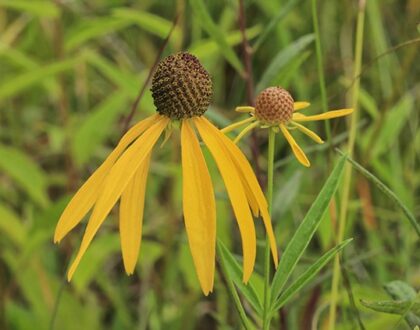
Ratibida pinnata
Grayhead Coneflower
 Please register or login to build your personal plant list.
Ratibida pinnata (Greyhead Coneflower) is a tall, sun-loving perennial whose drooping yellow petals...
Description:
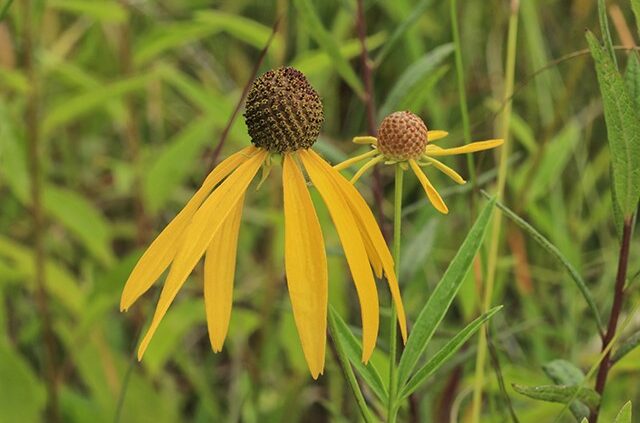
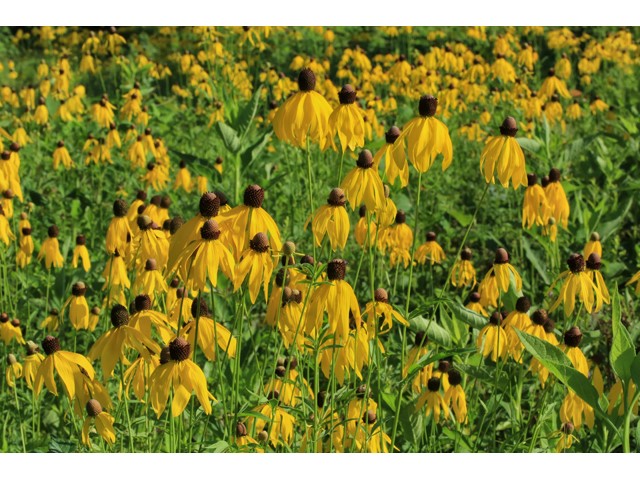
Ratibida pinnata is a garden workhorse: it grows tall and sturdy, typically 3 to 5 feet, and spends much of the summer holding up cheerful yellow flowers that are easy to spot and even easier for bees and butterflies to land on. Its unmistakable shape is bright yellow ray petals that droop gracefully from a rounded, grayish-brown central cone. Brush against that cone, and you might catch a faint anise-like scent, a subtle detail that makes the plant feel almost like a prairie secret.
Greyhead Coneflower thrives in full sun to partial shade and tolerates a wide range of soils (sandy, clay, dry, or moist), making it a forgiving choice for homeowners new to native gardening. In fact, it does best when it’s left alone: too much water or fertilizer makes the tall stems flop over, so planting it near sturdier neighbors or in the back of a border gives it the support it needs to stand tall. Because it self-seeds readily and spreads into natural-looking drifts, it’s ideal for meadows, rain gardens, and open woodland edges where it can do what natives do best: settle in and thrive without fuss.
Greyhead Coneflower attracts bees and butterflies, and its seeds draw birds through late summer and fall, weaving the garden into the larger food web. Native to prairies and open ground across the central and eastern United States, from the Great Plains to the Mid-Atlantic, it’s considered adventive in New Jersey: it grows and thrives here, but it is not part of the state’s original native flora.
Plant information compiled from the Lady Bird Johnson Wildflower Center Native Plant Database (wildflower.org) and the NC State Extension Gardener Plant Toolbox (plants.ces.ncsu.edu).
Plant Details:
Other Common Names: Drooping Coneflower
Plant Type: Flower, Perennial
New Jersey Native: No
Bloom Times: Late Spring to Early Summer, Summer, Late Summer to Fall
Bloom Colors: Yellow
Deer Resistance: Some
Attracts Pollinators and Wildlife: Bees and Other Pollinators, Butterflies, Birds
Salt Tolerance: Unknown
Hardiness Zone: 6a, 6b, 7a, 7b
Physiographic Region: All Regions in NJ
Soil Characteristics
Soil Type: Loam, Sandy, Clay
Soil Moisture: Dry, Moist
Soil pH: Neutral, Slightly Alkaline
Light Needs of Plant
Optimal Light: Full Sun
Light Range: Full Sun, Partial Shade
Water Needs of Plant
Soil Moisture: Dry, Moist
Drought Tolerance: High
Size and Growth Rate
Height: 3 - 5 ft
Spread: 1.5 - 2 ft
Growth Rate: Medium